Tuesday, 9 September 2014

A CRACK IN THE SIDEWALK


Concrete or asphalt covers a large percentage of urban and industrial areas. These are very hostile environments which are not favorable for most living things. There is no soil, and extreme fluctuations of temperature and moisture are the norm. Such places are essentially artificial deserts. However, things do live in deserts and things do live on sidewalks, but not many things. This is an artificial ecosystem where the only living things are those that are adapted to harsh conditions. It is an ecosystem that very few people are even aware of, but one that we see every day. It is also a fascinating one, which beckons from our doorsteps. It is an ecology you have to study on your hands and knees, preferably with a magnifying glass.

The concrete itself may appear totally devoid of life, but that is not the case. It is covered by micro-organisms. Even in the middle of a well used sidewalk there are thousands of species of bacteria. At the edges of the sidewalk where few people walk, you begin to see the first visible evidence of living organisms. There is often a green layer of algae. This alga coating is only one cell layer thick, but is easily seen because it forms a continuous coating over the concrete surface. It consists of single cells, but these cells do the same thing that leaves of higher plants do. They contain chlorophyll, which combines water from the surface of the concrete, and carbon dioxide from the air to produce glucose and oxygen. So even the sidewalk is doing its little bit to combat global warming. The most common alga here is probably Pleurococcus, the same one that forms green coatings on tree trunks and fences. Old fences are also combatting global warming.

On the edges of sidewalks you will often see pale circular patches. Some of them are chewing gum, but others are crust lichens. You will need to look rather closely to tell which are which. If a patch has tiny round saucers on it, it is a lichen. A lichen is a composite organism composed of an alga and a fungus. The alga part carries out photosynthesis and the sugars produced are also used by the fungus component. Lichens produce quite a few unique acids, and these acids slowly dissolve the sidewalk. This, however, is a very slow process, so the concrete is not going to disappear any time soon. The most common crust lichen on road and sidewalk edges is a member of the genus Lecanora.

If you have a magnifying glass you may see springtails and mites wandering about. These animals are just barely visible without a lens, but you need the lens to see anything about them. Most of them are feeding on algae, micro-fungi or bacteria. You will undoubtedly see several species of ants, foraging for whatever they can find. Some of them also prey on the springtails and mites. 

Which brings us to the cracks. Sidewalks and roads have cracks, grooves and depressions. Small amounts of soil form, or get washed into these cracks, and it is here that annual flowering plants and mosses can attain a foothold. Look along the green line between one piece of concrete and another piece. The plant diversity here is not tremendously great, but there are a number of different plants in several families. They share a number of factors in common, and these factors do not relate to how closely related the plants are. They are characteristics concerned with their ability to adapt to this harsh environment. The limiting factor here is not competition with other plants, which is often the most important factor in other environments. It is the extremes of the physical environment - heat, drought, and lack of nutrients.

If the crack is very shallow, there is not enough soil for even a small flowering plant. Such a crack, however, favors very small mosses that are adapted to extreme habitats. These mosses are often ones that grow on limestone, as concrete is alkaline, and functions as artificial limestone. There are three common mosses in such sites - Bryum argenteum, Bryum bicolor, and Ceratodon purpureus. The most distinctive one is the silvery bryum (Bryum argenteum). It is shaped like a tiny worm, with the leaves pressed closely together, giving the plant a cylindrical shape. It has a silvery sheen because the leaf tips do not have any chlorophyll. 


                                                                               Silvery Bryum - Rosemary Taylor.

If the crack is a little bigger it favors two small weeds that are not much bigger than mosses. They both have tiny narrow grasslike leaves, but they look quite different when in flower. You need to look very close, though, to see the flowers. They are very tiny. The bird’s-eye pearlwort (Sagina procumbens) has four green petal-like sepals. The other species, red sand-spurry (Spergularia rubra) has little pink flowers with five petals.


                                                                          Red Sand-spurry - Rosemary Taylor.

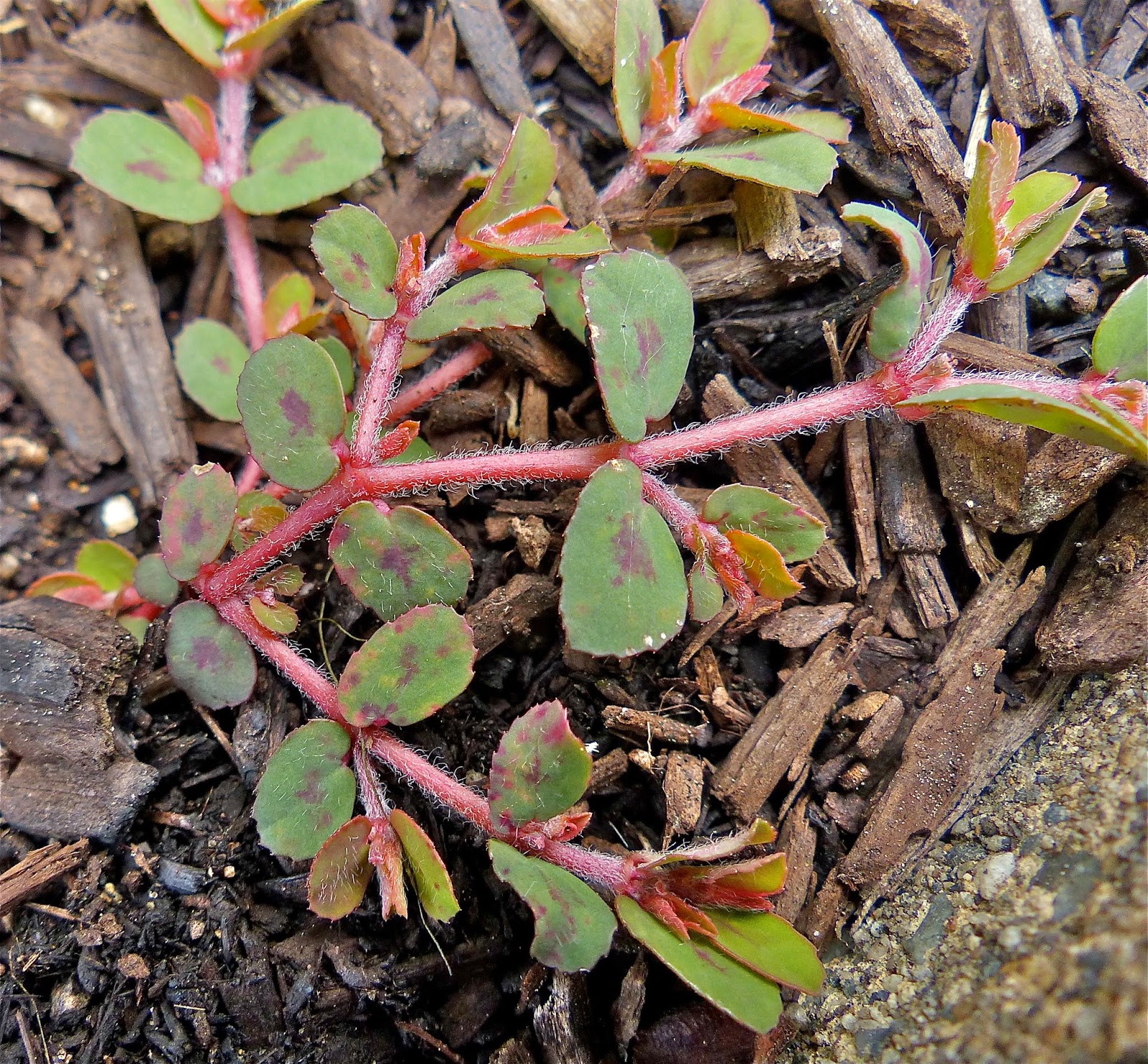
On southern Vancouver Island a recently introduced weed from farther south in North America is spreading on sidewalk areas. This is the spotted spurge (Chamaesyce maculata). Maculata refers to a single dark spot on each of the plant’s lopsided leaves.


                                                                        Spotted Spurge - Rosemary Taylor.

If the crack is larger still, bigger plants such as white clover (Trifolium repens) and Kentucky bluegrass (Poa pratensis) can get a foothold.

Next time you walk down the street have a closer look at your sidewalk. Even here you will find some of the wonders of nature, and see some of the processes of ecological adaptation.


Thursday, 27 March 2014

A Lichen Invader


There is a great deal of concern regarding invasive species.  However, when most people think of invasives they usually think of plants or animals. Did you realize that there is a recently introduced lichen that is rapidly expanding its territory in southwestern British Columbia? 

This invading species is the Maritime Sunburst Lichen (Xanthoria parietina). It was first recorded from the province about 15 years ago, from the Fraser Valley. The 1994 British Columbia Ministry of Forests publication The Lichens of British Columbia does not list it as occurring here because the first record of Xanthoria parietina in BC did not occur until about 5 years after this book was published. Now the situation has changed considerably. This is no longer a rare species, but a common one that is doing what invasive species usually do. It is rapidly expanding its range. It now grows as far east as Hope, and as far west as Qualicum Beach and Parksville on Vancouver Island, as well as on Galiano Island. It is well established in Steveston, and at Ambleside Park in West Vancouver. One area where this lichen does not appear to be introduced is within the city limits of Vancouver itself. It is reported to be sensitive to air pollution, and that may explain this seeming anomaly.

Some significant questions are, where did it invade from, and how did it get here? As with so many questions regarding origins, these are unknowns, but there are some quite logical explanations. This is a common species in eastern North America and Europe, and it has been known for some time from the Pacific Coast states to the south of us, where it is probably not native. It grows on deciduous tree trunks and branches, and occasionally on concrete. The vast majority of them grow on planted trees in urban areas, with only a few observations on native alder trees. Most likely the Maritime Sunburst was growing on horticultural trees which were brought from one of these three areas. When a living tree or plant is transported from one area to another, it is not just the plant that is transported. There is a whole ecosystem of small organisms, most of them microscopic, that come with it. 

Xanthoria parietina is a very showy distinctive lichen, so it is fairly easy to spot at a distance and to note how fast it is spreading. In open sunny areas, and most street trees are in open sunny areas, it is bright orange. These are large leafy, wrinkled lichens, and in a good growing site, may be up to 15 cm. across. They are usually much smaller than this, because they eventually make contact with others, so that large areas of tree trunk may be entirely orange in color. In shade they take on a yellowish gray tint. The difference in color is a good example of an organism protecting itself. The orange is a pigment that protects the lichen from ultraviolet light. In the shade less of it is produced, and so a more yellowish tone is produced. On closer inspection you will see that the lichen surface has several tiny saucer-like discs on it. These are reproductive structures. They produce spores which can be carried by air currents to other trees. Whether these spores successfully establish new lichens on other trees in our area, is another unknown.


Xanthoria parietina 
 Photo by Rosemary Taylor 

Is there a problem? Nobody knows, but there is certainly a problem for other small lichens that grow on tree trunks. The trunk of a tree is an ecosystem of small organisms - lichens, mosses, liverworts, algae, as well as the insects and mites associated with them. The Maritime Sunburst Lichen rapidly overgrows the small lichens around it. Very little research has been done concerning micro-ecological interactions such as this. 

If you live in a community close to Vancouver investigate the urban trees in your neighbourhood. The Maritime Sunburst is probably there, or will be there in the near future.     

Sunday, 10 February 2013

The Piltdown Mushroom

Since I study mushrooms I sometimes receive images from people asking for identifications. One of those images was something I had never seen, nor seen anything in the literature that vaguely resembled it. It was a rose coloured cup fungus with a papilla in the centre, and was growing on the trunk of a living shrub. The bark of this shrub was perfectly healthy, showing no signs of pathology.

The first possibility that came to mind was a species of ascomycete cup fungus, but to my knowledge none of those has a little bump in the middle. The next possibility was a bird’s nest fungus. These often grow on wood, and have peridioles, spore bearing structures, in them. They, however, have more than one peridiole, and do not grow on living trunks. It was a total mystery to me, so I advised the enquirer to contact several people with a better mycological knowledge than mine.

I was very intrigued by this fungus. Maybe it was a totally undescribed genus. The description of its location was beside a trail close to where I live, so I decided to set out on an expedition to locate it. Such a find should be documented with a herbarium voucher. Since I walk this trail, and know its fungal flora very well, it was perplexing that such a unique species could be growing there.

Upon setting out I met somebody who asked me where I was going, and I explained that this very unusual cup fungus had been seen along the trail, and I was going on a search for it. She replied that she had seen them a few days earlier, and that they were very clever. Somebody with a knowledge of mycology must have made them!

After a careful search along the trail, there they were. Seven of them on a vine maple (Acer circinatum) trunk surrounded by the cat tail moss (Isothecium myosuroides). Creatively constructed from pink plastic, with long stems inserted into the epiphytic moss carpet. 


Piltdown Mushroom
Photo by Rosemary Taylor

The amazing plastic cup fungi. Artificial ascomycetes in the prime of maturity. It brought to mind the Piltdown man hoax of a century ago, or the photos of flying saucers that used to intrigue me when I was young. The images certainly looked very real. How long will they fruit on that tree?                                                                                   

Tuesday, 29 January 2013

Agarikon - Old Growth Medicine

In the old growth forests of coastal British Columbia there is a fungus which has been used medicinally for 2000 years. It is a bracket fungus called agarikon or quinine fungus (Laricifomes officinalis, Fomitopsis officinalis). Bracket fungi are the shelf shaped wood decay ones that grow on trees and logs. Most of them are perennial and continue to grow for many years. They make a new layer of spore producing tubes on the underside of the bracket each year. If a bracket fungus is cut in half, you can see the annual layers analogous to the annual rings in a tree trunk.

The agarikon is one of these bracket fungi, but a rare and unusual one. It grows high up in the canopy of very large, old trees, and the brackets can live for many decades. If it is on the trunk it is hoof shaped like many other shelf fungi. On a branch, however, it tends to grow vertically downwards, like a thick white icicle. If you see one, which is unlikely, it is usually well beyond reach. To actually get your hands on it, you need to find a big fallen tree. The generic name refers to Larix, the larch tree, for in Europe it grows on old larch trees. In BC its host is Douglas fir. Like all such fungi, what we see is the fruiting body, essentially a spore producing flower. The growing parts of the organism are felts and hyphal threads which grow through the tree year after year, as it is a parasite on these old trees. 

The fruiting body is a chunky white structure and the annual layers are quite apparent even without sectioning it. Unlike other shelf fungi it is soft and chalky on the surface, and is very bitter. Identifying fungi by taste is a common practice among mushroom lovers, but a warning is in order. If you taste an unknown fungus do not swallow any of it. There are many toxic fungal compounds. 


Agarikon (Laricifomes officinalis)

In all the years of studying fungi, I had never seen the agarikon in nature. Except for two specimens I retrieved from mushroom shows, of unknown origin, it remained very elusive. That was until last year, on a Nature Vancouver hike through an old forest near Hope. A centuries old Douglas fir had recently fallen beside the trail, and attached to it was an agarikon! Its chalky white surface was unmistakable.

What is so special about this fungus? Its rarity is, of course, one of the significant features. It only grows on old trees, and even in old growth forests it is uncommon. As old growth forests are now uncommon, the agarikon is even more uncommon than it once was. Although it has been known in Europe since at least Roman times, it is almost extinct there now. Very few old growth stands remain in Europe. There are reports that it now survives only on larches in the Slovenian Alps. 

Strengthening the case for protecting agarikon and its old forests, is research on the medicinal potential of this fungus, and the importance of maintaining as much of its genetic diversity as possible. This research has uncovered both antibacterial and antiviral activity. Agarikon has been used traditionally to treat both tuberculosis and smallpox, and First Nations probably also used it as a medicine. Figures carved from agarikons were sometimes placed on the graves of shamans.

The potential of this fungus is yet another reason for preserving our old growth forests. The loss of agarikon could very well result in the loss of effective treatments for serious diseases. There are also other fungi restricted to old growth stands, and the medicinal properties of fungi have been poorly researched. With the rapid advances in molecular biology and biochemistry that are now taking place, the promise of agarikon and other forest dwellers may yet be realized, provided we protect the habitats where they dwell. 

Friday, 7 December 2012

A Moss Mystery

If you observe nature closely enough and long enough, you begin to notice changes and anomalies. I am probably more interested in mosses than any other organisms, and as a result observed something I had never seen previously. Whether any other naturalists noticed it, I do not know, but for a bryologist it stood out loud and clear.

In the spring of 2011, while walking along the Cleveland Trail in Pacific Spirit Park I saw that one of the mosses, Ulota obtusiuscula, had died. This is a common moss that grows on alder trunks, where it forms compact dark green clumps. When dry its leaves are very shriveled, much more so than other mosses. It often has spore cases, and the cap which covers these cases has many little projecting hairs. If you are interested in finding Ulota, these are the three features to look for. 

On this particular day not only were the Ulota shriveled but every clump on every alder trunk along the trail edge was brown and dead! There are several other mosses on these trees, and none of them showed the least sign of being unhealthy. First conclusion was that something had occurred along this trail, and poisoned the Ulota, but that no other species was as sensitive as this one. 

Ulota obtusiuscula
Photo by Terry Taylor

It has been claimed that there is a psychological principle which states something to the effect that if you notice something unusual or it is pointed out to you, you will have difficulty not seeing it on future occasions. I could not help but be aware of Ulota everywhere I went, and it soon became apparent that this dieback was not a local thing. It was all across the Lower Mainland. As of autumn 2012 the little dead moss clumps are still clinging to the trees, and I also saw some on alders on the lower slopes of Mt. Fromme

How does Ulota differ from other mosses? For one thing it is adapted to grow on the driest, most exposed parts of the tree. Mosses with this growth form are those of extreme environments. Mosses which creep across the substrate require humid conditions. That is why they are the dominant growth form in shady forests. Look at a big leaf maple trunk. you will see that creeping mosses occupy the lower levels, but the branches are covered by mosses in clumps.

The other mosses on these tree trunks are clustered on the lower, humid zones of trunks, or in cracks, and other sites where conditions are less extreme. The Ulota is found on the smooth bark where the other species do not grow. Maybe Ulota occupies a niche too dry for its competitors, close to the edge of survival. If conditions remain stable there is no problem. Something like running out of food in the refrigerator. No problem as long as the grocery store is open. I do not know if there was an extreme weather event at that time, but have never experienced a Ulota catastrophe in previous years. 

There may be many processes taking place in nature that few notice, or that nobody notices. Others that I have seen over the years involve slugs and ants. The common slug in the forest is the banana slug (Ariolimax columbianus). The common one in urban areas is the black European one (Arion sp.). The black slug did not live in the forest, but now it is fairly common in the surrounding second growth conifer stands. Does it compete with the banana slug or do they eat different things? Probably nobody knows, but there may be a problem here. 

During the 1950’s and 1960’s an ant that belongs to the Formica fusca group was extremely common in Vancouver. When I was a child I used to call them sidewalk ants, because they could be seen running rapidly across sidewalks all over town. Now these ants are very rare within the city limits, although they are still common on mountain tops, and are found in surrounding areas. 

If you look closely for long enough you will notice changes taking place in our local ecology. Some of these are rapid like the moss dieback. Others are slower like the ant and slug ones. They all, however, indicate some sort of environmental change, although the nature of this change may be hidden from us.

Saturday, 24 November 2012

The Autumn Colours. What are They?

One of the wonders of autumn, along with the flowering of the mushrooms, is the spectacle of the autumn colours. You do not need to be a naturalist to appreciate this. Unlike many natural processes there is nothing subtle about this change. Virtually everybody notices these brilliant colours, even though few know anything about their causes and chemistry. In eastern North America there is a tourist industry based on this phenomenon. Rooms in the eastern deciduous forest may be booked up a year in advance.

Why do leaves show these striking reds, oranges, and yellows before they fall? Like may other natural processes, the basics are known, but many of the details have yet to be discovered. 

The shedding of leaves by deciduous trees and shrubs is  a complicated procedure. Deciduous species are not able to grow and photosynthesize under winter conditions. The conifers, in contrast, are the trees of cold areas. They have turned their leaves into narrow needles with minimum surface area, and protected them with a thick waxy surface. One of the problems for plants in winter is desiccation. When the ground is frozen, water is not able to enter the roots. If too much evaporation takes place such a situation can prove fatal. Conifer needles are an adaptation to this. They still photosynthesize through the winter, but decrease the surface area where water loss can take place. Larches (Larix spp.) are an exception to this rule. They are deciduous conifers that shed their needles in the fall. It is believed that this is an adaptation to extreme winter cold, as many larches grow in the high north or at high altitude, where the ground is completely frozen for much of the year.

Broad leaved trees are able to survive in colder climates, by growing in the summer, and going into dormancy in the winter. Before going into this dormancy they take some of the nutrients from the old leaves, and store them over the winter. These are then used next spring to supply a short spurt of food to the newly developing buds. The base of the leaf also forms a weak corky layer of cells, called the abscission layer. This is weaker than the original leaf base. The old leaf is now supported by the vein of woody tissue which at one time brought water into the leaf, and transported glucose from the leaf to the rest of the plant. The weakened vein eventually breaks, and the old leaf falls to the ground.

The predominant colours in autumn leaves are yellows and reds, and the pigments that make these colours are produced in quite different ways. The yellows are most often due to pigments called xanthophylls. They are present in the leaf right through the growing season, but you cannot see them because they have been hidden by the green of the chlorophyll. Chlorophyll continually breaks down and is replaced by new chlorophyll. When the old leaf is cut off from the tree’s nutrient supply, no new chlorophyll is made. Xanthophylls are more stable than chlorophyll and take longer to break down. They are  light gathering compounds and collect light in frequencies where chlorophyll is less efficient. They also protect chlorophyll from excess light. Chlorophyll can be degraded if the light intensity is above that which is needed for photosynthesis. Xanthophylls absorb some of this excess. One place you probably see xanthophylls is at the breakfast table every morning. They give the yellow color to egg yolks, and this originates in the leaves eaten by the chicken.

The reds are quite different from the yellows. Autumn reds are not there during the growing season. They are usually due to anthocyanins, the same compounds that make blueberries blue. As some leaves begin to die, sugars accumulate. Normally these would be exported to the rest of the tree. Sunlight reacting with these sugars produces the anthocyanins. One tree that illustrates this relation to sunlight is the vine maple (Acer circinatum). In shady forests its leaves turn yellow, but in sunny sites they become a bright red. Young emerging leaves in the spring may also have a red tinge. This is also due to anthocyanins. They protect the newly developing leaves from damaging ultraviolet light. There is also evidence that they may also serve a protective role in senescing leaves. 

Our most common deciduous tree, red alder (Alnus rubra) does not change color at all. It just dumps its leaves when they are still green! Alders have nitrogen fixing bacteria (Frankia alni) in their roots. These take nitrogen from the air to produce ammonium compounds as fertilizer for their host tree. The alder does not need to hold on to its leaves until they deliver some of their contents back to the tree. For most trees availability of nitrogen is a limiting factor for growth. It is like money for most people. Alders have all the currency they need to do whatever they want. When its leaves fall this currency is delivered to all of its neighbors.

In eastern North America there is a tourist industry based on the autumn leaves. This is the area of the eastern deciduous forest. Not only are there more deciduous trees to create this spectacle, but the cooler temperatures, and bright sunny days favor the development of bright red leaves. In Vancouver most of our fall colouration is produced by street trees, some of which are native to the eastern forest. Two frequently planted ones which give a good show are the red maple (Acer rubrum) and the sweet gum (Liquidambar styraciflua).


                                                               Red Maple Leaves
                                                          Photo by Rosemary Taylor

There are, however, places to go to see local native species with beautiful fall displays. Although our forests are coniferous, our shrubs are deciduous. In the mountains where shrubs of the heather family dominate the subalpine slopes and ridges, there can be magnificent panoramas of yellows, oranges, and reds. The closest of these displays for Vancouverites are the ski slopes of Hollyburn Ridge, along the trail to Hollyburn Peak. During an October with sunny days these slopes can be stunning.

The most striking colours are from the blueberries. Since these are the dominant shrubs of many subalpine slopes, these slopes can be a painted a brilliant red, visible from kilometres away. The most common species at Hollyburn is the Alaska blueberry (Vaccinium alaskaense). It tints the ski runs a purple red. Mixed with it is the black huckleberry (Vaccinium membranaceum). Ordinarily you need to look at them up close to distinguish one from the other. But at this time of year that is not the case. Its leaves turn a brilliant red and the two species can be identified from a distance. Scattered among these reds are splashes of yellow from copperbush (Cladothamnus pyroliflorus), and white rhododendron (Rhododendron albiflorum). The white rhododendron has a way of changing color that is unlike that of any others of our native shrubs. The leaves do not turn completely yellow. They develop a yellow spot on a completely green leaf. This spot gradually increases in size until the entire leaf yellows. 


                                                                    Hollyburn Colours
                                                             Photo by Rosemary Taylor

Scattered among the major players of this display are some lesser ones that fill in the gaps. Fireweed (Epilobium angustifolium) patches present their red withering leaves. Devil’s club (Oplopanax horridus) is yellow. The occasional Sitka mountain-ash (Sorbus sitchensis), even though it is in low numbers, stands out because its leaves often turn orange. 

A trip up to Cypress Provincial Park on a sunny October day is well worth the effort, and if you are looking for some exercise you can continue past the little lakes, and up to the peak for its panoramic view across Burrard Inlet to Vancouver.

Autumn displays with all their beauty are still shrouded to a great extent with mystery. Although the basic processes are now understood, the details have yet to be unravelled. Modern tools of molecular biology and biochemistry, however, are rapidly filling these details.   


Tuesday, 4 September 2012

The Kitsilano Natural Foreshore

Between Jericho Beach on the west, and Trafalgar Street on the east, lies the only section of undeveloped beach within the city of Vancouver. Contrary to what some people believe, this whole stretch of foreshore is public land, and is relatively easily reached from a number of access points. These points are located at Jericho Beach, Dunbar Street, Waterloo Street, Balaclava Street, Bayswater Street, Volunteer Park, and Trafalgar Street.

Other shoreline areas in the city such as Stanley Park, English Bay, Kitsilano Beach and False Creek are also public land, but all of them differ significantly from a natural foreshore. They are dedicated to active recreation, and the natural environment has been significantly altered. Between Jericho and Trafalgar, although the land has been converted to residential properties, the beach itself remains little altered from what it would have been like several centuries ago. There are many features and organisms here to entice the curious naturalist. It also remains an area for passive recreation, an oasis different from the frenetic pace of the other beaches. Such places are now difficult to find within the city.

There is, however, pressure to change this situation. A proposal has been made to build a seawall along the beach. Such development would seriously impact this last remaining piece of natural foreshore habitat. Contrary to some claims there are natural features here worthy of preservation.

In this article, we will take a walk along the beach from west to east, and look at these features. Before starting, however, there are a few safety precautions. This is a natural beach. For most of its length it lies at the base of a cliff. At high tide the sea comes up to the cliff. Before you take your walk check the tide tables on the Internet to make sure you can safely proceed. Also take note of the access stairs which are located approximately every two blocks. These will take you up to Point Grey Road, so you can explore the whole beach or just a portion of it. Where there is no sand the rocks are covered by a biofilm of diatoms. We will get back to the importance of diatoms later. Of immediate concern is the fact that this biofilm is very slippery and you can take a bad fall. So be careful walking across it.

The information here is gleaned from both my own knowledge of the beach, that I have acquired over the years, and also from other members of Nature Vancouver with whom I have visited the foreshore recently.

So let us begin with an overview of what is here. When the tide is out and you look to the north, you see a flat area stretching out to the water’s edge. Geologists call it a wave cut platform. The present site of Vancouver was below sea level during glacial periods, being pushed down by an ice sheet several kilometres thick. When the ice retreated, 11,000 years ago the land rebounded, and the cliffs which now lie at the back of the beach were out at the edge of the platform. The action of millennia of storms have cut away at them and left the platform which is now exposed at low tide. At the base of the cliffs you can see an undercut zone, where the sea is cutting into the present cliff. 

Although the platform is flat, you will notice that some of the rock strata on it, especially close to the beach are inclined. They are steep on the north side, and slope gently on the south side. The sea has not yet had time to completely level them. They are tilted because of the North Shore Mountains. The sediments were originally laid down flat, but that was long before the North Shore peaks existed. The original hills were worn away and their components deposited in places like this. Continental drift is pushing the Pacific Plate against North America, and part of this process has produced the local mountains. As the peaks have risen the rocks here at the beach have been tilted, so that they slope slightly to the south.


The tilted platform
Photo by Terry Taylor

Along the platform is the biofilm of diatoms. This is the brownish slippery coating over the sediment and rock surface. At a lower level than the sandy beach there is a coating of clay and silt. This has been deposited both as silt brought from the Interior and the Rockies by the Fraser River, and by the action of the sea upon shale within the cliffs. The upper beach is sand because the scour of the tides is stronger here and removes the finer materials. It is upon the silt and exposed rock platform where the diatoms and other micro-organisms can find a safe haven, and can establish themselves. Diatoms are single celled algae, or short chains of such cells. They are distantly related to brown seaweeds. Under the microscope they are very beautiful, and are reminiscent of bivalve mollusks. They cover themselves with two shells, but these shells are not calcium carbonate. They are made of silica, and are transparent, like two halves of a petri dish. Diatoms may not seem very important, but they, and other micro-organisms, are the beginning of the food chain. They feed juvenile fish, or the crustacea that are eaten by larger fish. Although, we are usually aware of the big organisms only, biologists have estimated that half the weight of the biosphere is composed of the microscopic ones.

Also very noticeable along the edges of the beach are rafts of seaweeds. The tides have torn them from the rocks and brought them ashore. As they decay they are eaten by crustaceans. The ones that jump about are often called sand fleas, although they have little in common with fleas, except that they are very good jumpers. They do not bite. If you lift up some seaweed you may see hundreds of them. They are food for the smaller fish, which in turn feed the larger fish such as salmon. There are two main species of seaweeds here. Most common is the rockweed (Fucus gardneri). This is the brown one which covers intertidal rocks. It has the floats which dry out and go pop when you walk on them. The other is sea lettuce (Ulva lactuca). These are the green sheets that look like thin lettuce. It is a green alga, related to the ancestors of land plants.

The beach too, has a tale to tell. Many of the pebbles here have been brought down by the Pleistocene ice sheet from the North Shore Mountains and beyond. They were dumped in the ocean by the advancing glaciers. The Point Grey Peninsula rose above sea level after the ice left, as the glacier was no longer pushing it below sea level. The sea cut away at the cliffs over the centuries, and the pebbles ended up on the beach. The smaller pebbles are also significant for another reason. During the summer, when the tide is in, smelt lay their eggs on them. The eggs hatch in a couple of weeks and the larval fish swim out to sea, feeding on micro-organisms as they migrate. Smelt are now a threatened species. They need all the help they can get to re-build their population levels. Overhanging shrubs and trees along the upper beach are also important for smelt spawning, as their shade cools the beach when the tide is out. These spawning gravels along the beach may be protected by fisheries legislation. During August, when I was in elementary school, and the tide was full in the evening, I often came to the beach with my smelting net.

Take a look at the cliffs when you have a chance and you will see that they are composed of two different types of rocks - sandstone and shale. These deposits are remnants of the ancient history of the British Columbia coast. They originated 40 million years ago, during the Eocene Epoch, and were laid down as sediments along the channels of rivers that have long ceased to exist. These rivers flowed westwards from a range of low mountains that fronted the coast millions of years before our North Shore mountains were uplifted. The sandstone was formed where the currents were flowing strongly, and the shales from fine clay in gently moving backwaters. If you go down to the Fraser delta and look at the estuarine plants along the edge you will see evidence of a similar process. These plants are covered by a gray coating. This is fine silt carried by the river from the interior of the province. 

In some spots there are sandstone layers that actually show how the river was flowing, possibly on individual days, so many millions of years ago. Within the layers of sand are occasional thin black deposits of organic material. These stand out from the lighter colored sand layers. You will see that some of them are tilted slightly from others, indicating how the currents were changing their course.

As we walk eastward from Jericho we will stop at various features of interest. The first of these is along the sand near the Royal Vancouver Yacht Club. At this site you will see what a natural, undisturbed deep sand beach looks like. There are two robust grassy plants here. On the right, shoreward side is the dune grass (Leymus mollis). This is a very large grass that can grow up to two metres tall. Notice how thick and tough the wide blades are. This is an adaptation to the harsh conditions posed by growing in sand. These blades resist the abrasion of wind blown sand and also retard water loss. Upper layers of sand can be very dry, plus the fact that the water which does occur at lower levels is often salty, and not easily absorbed by plants. The dune grass also has a gray coating to retard water loss. It has deep roots which penetrate down to the water table, and stabilize the plant in this shifting unstable environment.

To the left, the seaward direction is a plant with shiny grass-like leaves. This is a grass relative, but not actually a grass. It is a sedge, the big-headed sedge (Carex macrocephala). The leaves are smaller than the dune grass and are a bright green color. It grows close to the sand in little tufts. These tufts are sometimes in straight lines as they are often not single plants but shoots attached at intervals along long, horizontal, underground stems. The most noticeable feature of big-headed sedge are the compact clusters of dark brown seed heads. The seeds themselves are contained within seed cases that possess two sharp points. This sedge is now reported as a rare plant in Washington State.

The next point of interest is just down the beach, where the sandstone cliff begins. Projecting from the cliff as well as upon the beach are large rounded sandstone boulders. This is the only site along the entire foreshore where these strange boulders are found. They are called concretions, and they consist of sandstone which has been cemented together by calcium carbonate, deposited within them by water. They stand out because they are harder than the surrounding rock, and are, therefore, more resistant to weathering. How this lime material was deposited, why it is here and not in other parts of the cliffs, and how old it is, are all unknown. One of the geological mysteries of the Kitsilano foreshore, and one which is worthy of protection. 


One of the mysterious concretions at Jericho Beach
Photo by Terry Taylor

The next feature is just east of the Dunbar Street access steps. It is right at the base of the cliff, where the force of the waves is cutting into the rock. It is at the cliff base where the energy of storms is at its greatest. Basically what they are doing is gradually extending the wave cut platform landwards. At this particular undercut there is a layer of shale with black coatings on it. If you look closely you will see the impressions of leaves. These are fossils of leaves from deciduous trees which once grew along the river banks 40 million years ago. When you look at one of these leaves you are looking at something that happened one autumn of one year, so many eons ago. These were deciduous trees. They shed their leaves during the fall the same as our trees do. The leaves fell into the river, were carried down stream until they became waterlogged, fell to the riverbed and were covered by silt which accumulated above them for century after century, metre upon metre.


One of the fossils from the cliff near Dunbar Street
Photo by Rosemary Taylor

About a block east of the Waterloo Street stairs is a strange looking rock formation projecting northwards from the shore. Most people just see it as an impediment that must be climbed over and makes them wait until the tide is low enough for them to proceed. This, however, is another structure worthy of protection. Notice that the central part of it is darker and harder rock that that on either side. It is a volcanic dyke. It is the only one along the entire beach. A similar dyke in Stanley Park has been dated at 32 million years, so this is likely to be of a comparable age. The dark central part is basalt or a related volcanic rock and it was pushed upwards from a magma chamber below it. These structures are the roots of volcanoes or lava flows. So, 30 million years ago there may have been a Kitsilano volcano, or a lava flow like the Columbia Plateau. Note that sandstone occurs on either side of the dyke. When the lava erupted it roasted the sandstone through which it was extruded. The sediments on either side are, therefore, harder and more resistant to erosion than the surrounding rock and we now have this long three layered stone sandwich. 

When you reach Bayswater Street, if it is a low tide, look out along the exposed flats. You will see there is a smooth area without rocks. This is a piece of local history. Over a century ago the rocks were cleared away and the English Bay Cannery was built here. Although this salmon cannery is long gone, the smooth surface bears witness to its existence. 

As Trafalgar Street is approached, look carefully at the cliff face. At one spot there are a couple of coal exposures. Again, these are the remains of the ancient trees that once grew here. 

The above features are some of the highlights along the Kitsilano foreshore. They contribute to making this beach unique within the city of Vancouver. Construction of a seawall would destroy this uniqueness and eliminate the last un-impacted beach within the city.    

Saturday, 11 August 2012

Timberline

As you hike up the mountain the trees gradually get smaller and farther apart. There are more sunny openings with wildflowers and views. Eventually, if you climb high enough the trees disappear altogether, and the ridges are occupied by low-growing shrubs. This transition occurs at about the 1800 metre level, and has been called the timberline. It is the zone where the snow stays so long into the summer that the growing season is too short for trees to survive. Only shrubs and herbaceous plants are able to live there. The snows do not melt until July and they come again in October. The plants that live here must leaf out, flower, and produce seeds in a period of three months, as they are snow-covered for three quarters of the year. This is the high country of alpine meadows and heather-covered summits. The bare rocks contrast sharply with the brilliant colors of the wildflowers. This is the country that enchants both the naturalist and the hiker. It is an environment which is rugged and delicate at the same time.


The lake in this photo is at 1900 metre elevation.
Photo by Kelly Sekhon

The low elevation forest along the coast is often referred to as the rainforest, because of the high rainfall levels. The higher elevation forest has been called the snow forest, as snow has more influence here than rain. Although snow cover lasts into the summer or late spring, the growing season is still long enough for trees to develop. As you hike through this upper forest, however, there are signs and indications that you are approaching the high country. Some of these indicators are the changes in the species of trees themselves. Even if you do not know the names of these trees, you will still see that they are different from the familiar trees near sea level. Those familiar trees are gradually replaced by others which are more adapted to the long winters and harsher conditions. Redcedar (Thuja plicata) is replaced by yellow cedar (Chamaecyparis nootkatensis). Western hemlock (Tsuga heterophylla) gives way to mountain hemlock (Tsuga mertensiana), and Douglas fir (Pseudotsuga menziesii), which is not actually a true fir, is superseded by amabilis fir (Abies amabilis). The low elevation forest, because its most common tree is the western hemlock, is called the Western Hemlock Zone, and the high forest which is dominated by mountain hemlock is called the Mountain Hemlock Zone. 

There are a number of features about the Mountain Hemlock Zone which tell you that you have reached the high elevation forest even before the trees begin to thin out. The thick snow  cover lasts well into the summer, at which time it becomes very hard and treacherous, especially on steep slopes. At such times it is advisable to have an ice axe and know how to do a self arrest. Another hazard on these slopes are deep tree wells. The snow melts away from the sides of the tree trunks. The trunks are dark and absorb heat, and there is also a small amount of heat released by the trunks themselves. In early summer the larger trees are surrounded by these deep vertical shafts. Another reason for carrying an ice axe. Once the snow has melted another characteristic of the trunks becomes visible. The tree itself may be vertical, but the base usually curves downhill. This twist was produced when the tree was young and small. For the large trees that was centuries ago. The weight of the snow bends small trees. It is only when they are older that they can become tall and straight, but the evidence of the long ago formative years remains. 

As the growing season becomes less and less, the trees get smaller and smaller, and farther apart. This means that sunlight can reach the ground, and is not blocked by the needles on the trees. If there is enough moisture herbaceous plants are able to grow, and they do so in great profusion. These are the subalpine meadows, and in July they present a panorama of colors. They  have little time to flower and set seed, and so they do so rapidly, and with a blaze of glory. With so many flowers it would seem that there must be an equally large number of seedlings. But like so many other things in life, this is an illusion. There are many seeds, but very few seedlings. Unlike the plants at lower elevations, the harsh conditions of the high country allow only a miniscule number of these seeds to be successful. As you hike through the meadows, look and see how many seedlings you can see. Usually there are none at all! 

The meadows bloom in two waves. First there are the plants that are the most cold resistant. These flower close to the melting snow. As the soil warms the second wave comes into bloom. By this time the early ones are already in seed. Some of the first shoots actually push their way through the melting snow, although usually there is a brown zone of dead vegetation immediately adjacent to the snowbanks, and outside this is the green zone of emerging shoots. The first flowers to appear are the yellow snowlilies (Erythronium grandiflorum), the little white spring beauties (Claytonia lanceolata), and the white flowered western anemone (Anemone occidentalis). The later stage is dominated by flowers such as the blue flowered lupins (Lupinus arcticus), and the orange flowered paintbrushes (Castilleja miniata).

The meadowlands grow where there is rich soil, and abundant seepage. If you leave the meadows and hike onto the rocky, dry ridges you find a much more hostile environment. Rain or snow melt runs rapidly off these sites, carrying nutrients with it. This moisture and dissolved minerals runs down slope to the lush herbaceous plants below. There is a striking difference between the dominant vegetation of the rocky sites and the moist, deep soil slopes below. The ridges belong to small shrubs with tiny needle-like leaves. These are the heathers (Ericaceae). Heathers are adapted to live in such extreme environments. Their roots contain efficient microscopic fungi that help them gather water and nutrients in such sites. Their leaves are like tiny coniferous tree needles. They are small, evergreen, and narrow, and have thick surfaces which resist water loss. The shrubs themselves are short and close to the ground, so that they are covered by a blanket of protective snow in the winter. Because they grow close together they are able to lessen the effects of desiccating winds. There are two common heather species on these ridges, the pink mountain heather (Phyllodoce empetriformis), and the white heather (Cassiope mertensiana). The pink flowered species tends to grow at lower elevations than the white one. Its leaves look like the needles on many conifer trees. The white one is adapted to more extreme sites where the snow lingers longer. Its leaves are shorter and pressed close to the stem, like scale leaves on cedars. This is an adaptation to the more rigorous conditions at these higher altitude ridges. 

Where the trees give way to the meadows or ridges, you may notice that they present some unusual growth forms. In the meadows there may be a few tree islands. These are spots where the snow leaves a little earlier, and the growing season is just long enough for tree seedlings to get started. They usually occupy little hillocks where the sun can heat the ground a little more. Once one tree gets started it produces some protection against the wind, and also lessens the accumulation of snow, and so other trees can get started. In this way a small grove develops after several centuries. On the ridges trees are often dwarfed, and grow densely packed together. This growth form is called krummholz, meaning crooked wood. During the winter these sites are bitterly cold and windy. Any buds or needles projecting above the snow surface are killed, but those protected by the covering of snow are able to survive. Therefore, the trees cannot grow upwards, but they can grow sideways. Hiking along such ridges is difficult because of the impenetrable shrubby barrier.  

One feature you cannot fail to notice on the alpine rocks are the lichens. Even if you are not consciously aware of them, they still form part of the subconscious impression of what a high mountain ridge looks like. The dry surfaces of such rocks are very inhospitable for living things, but many lichens are specially adapted for living is such places, especially the ones that form thin crusts. The splotches on the rocks are usually lichens, not mineral coatings. Although they may not appear so on casual observation, they are alive, growing and reproducing. Their growth rate, however, is very, very slow. Most of the year they are covered by snow, and most of the time when they are not covered by snow, they are dried out by the sun. It is only during or shortly after rainy periods that they can actually grow. These splotches can come in a number of different shades and colors, and are more complex than they seem. They are simple ecosystems composed of two different organisms. Most of the lichen is composed of fungus threads, and among these threads are microscopic green plant cells - algae. The plant cells gather sunlight the way all plants do. They use this energy to combine water and carbon dioxide into sugars. The fungus part then uses some of the sugar to build its own cells. 


Some of the lichen species seen on rocks above the timberline.
Photo by Kelly Sekhon

Monday, 25 June 2012

Secrets Beneath the Ground

Of all the mysteries in the natural world, probably the most mysterious and least understood are the ecosystems which lie hidden beneath the ground. Not only are these ecosystems hidden under a layer of leaves and twigs, they are also hidden from us because their size is far below our level of sensory perception. There are billions of individual fungi, protozoa and bacteria in every handful of soil. By far the greatest number are the bacteria. Microbiologists have estimated that there are more than 10,000 different species of these tiny organisms in that little pile of soil! Most of them are so small that a line of 1000 of them, end to end, will only stretch for a distance of a millimetre.

Just as the forest has many different habitats such as streambanks, logs, tree trunks, sunny openings, etc., so does the soil have many different habitats. Soil habitats, however, are microscopic ones. Particles which have come from the breakdown of leaves, wood, bark, insects, minerals and many other sources are all different, and support their own unique populations of bacteria. Each one forms its own special ecosystem, an ecosystem with a diameter about one-tenth of a millimetre. Most of these bacteria have not only never been named, they have never been seen. So how do scientists know there is this much diversity under the ground? The people who study genes and molecular biology have extracted DNA from soil samples and analyzed it. Some of this analysis involves observing how long it takes for pieces of DNA to recombine with other pieces of DNA. The longer it takes, the more kinds of different DNA are in the sample. After the mathematicians have made their calculations, the conclusion is that there are more than 10,000 strains in a sample of good rich soil. This is more than three times the number of higher plant species in all of British Columbia! It is also twice as many species of bacteria than are described in Bergey’s Manual.

Bergey’s Manual is a multi-volume set of books that contains information on all the named species of bacteria. There are about 5000 of these. How can a few grams of soil contain more bacterial species than this? One of the most significant reasons involves how we study and grow bacteria. Most kinds of bacteria that are known, are known because they have been cultured on a Petri dish, a clear plastic dish containing agar, which is a nutrient-rich jelly substance. The nutrients can be varied, depending upon what kind of food the particular bacteria like to eat. If the bacteria like the food they are given they will form great big colonies on top of the agar. The average bacterium is only a thousandth of a millimetre long, so there are millions of individuals in such a colony. With this large a number, the bacteria in question can be studied in detail. To study bacteria in this way, bacteriologists must be able to grow them. They must be able to give them the food they like, and they must also be able to grow them in a monoculture, without other competing organisms. The species that can be cultured in this way are usually species that like lots of nutrients. Most of the pathogenic ones fall within this category.

Most bacteria, however, do not cause disease, and they do not live in habitats with lots of food. The bacteria we have names for are the ones we can grow. Scientists now believe that over 99% of species cannot be cultivated. In other words almost all the bacteria in nature are unknown. About 20 years ago biologists were first able to study the DNA from soil organisms, and these studies revealed that not only were there many times more strains of bacteria than had been surmised, but that the vast majority of these are not closely related to the known ones.  Many of those in the soil occur in very small numbers, in many different micro-ecosystems. Particles from such differing origins as insect skeletons, tree resin, leaves, wood, animal droppings, or different kinds of mineral grains will all have their own special types of bacteria, and there are innumerable kinds of micro-particles. Some bacteria appear to be dormant almost all the time, waiting in the ground until they receive the nutrients they require. When the food is exhausted they go back into dormancy again.

We cannot see the bacteria within their own environment. Some of them can be cultured in Petri dishes, but this is micro-agriculture, not nature. To study soil ecosystems themselves they need to be manipulated and disturbed, as these are worlds beyond our level of perception. To find individual organisms in this realm is more difficult than looking for a needle in a haystack, because we can see the needle when we find it. It is more comparable to clearing a piece of land with a bulldozer, and looking through the rocks to see what kind of mosses were growing there.

There is also evidence that bacteria have complex social relations with other bacteria. The majority of soil species may require contact with other soil bacteria. These requirements cannot be supplied in a laboratory environment. Bacterial cells talk to each other through a chemical language called quorum sensing. They produce substances which diffuse into their surroundings. When a critical level is reached they cause the individual cells to change their behaviour. They may tell them it is time to reproduce, or in the case of some disease-causing strains, there is a message that they have a high enough population to transform from a harmless state into an invasive, pathogenic one. Some of the most virulent disease organisms are completely harmless until they reach their critical density. Future medical treatments may involve neutralizing this communication system.

The majority of our antibiotics are produced by soil bacteria, and most of these come from a group of bacteria called Streptomyces. There are myriads of these compounds, and bacteriologists have discovered that in nature they do not act as antibiotics. They are used for chemical communication. The bacteria usually make them when they are ready to produce spores for reproduction. They, however, produce them in very small quantities, quantities which are below the minimum inhibitory concentration. This refers to the minimum amount of substance that is required to inhibit bacterial growth. The Streptomyces are grown artificially in pure cultures, which never occurs in nature where they occur with thousands of other micro-organisms. In large amounts, antibiotics disrupt the growth processes of other bacteria. That is the reason they can be used to kill disease organisms. Some researchers have expressed concerns about releasing these naturally occurring substances in unnaturally large amounts into the environment, which is what takes place in some agricultural settings.

As you walk through the woods, even if you can name every plant, animal or mushroom you see, you are only naming a small percentage of the diversity that surrounds you. Almost all of it is un-named and unknown, and will remain so for many decades to come. Scientists are only beginning to fathom the invisible ecosystems which are common here, and upon which all the larger living things depend. It is the soil and the secret realities within it that support all the ecology we see around us.

Thursday, 31 May 2012

The Spots on the Rocks

Have you ever seen speckled rocks? Rocks with gray or colored patches thinly covering the surface, patches that are not actually parts of the rock itself. Such spots are usually lichens. They are not just stains on the rock, but actual living organisms adapted to living in hostile, extreme environments that cannot be occupied by other living things, at least other living things that we can see. They are most frequent on rocks in open sunny locales, such as those on the seashore or on exposed mountain crests. In such places only organisms adapted to extremes such  as heat, cold, desiccation, or salt spray can survive, and these kinds of lichens are masters of the extreme. Such thin lichens are known as crust lichens. Rock surfaces in shaded forested sites are moister, and less severe, and usually covered by mosses.

Look closely at some of these patches and you will see that there are different kinds of patches, and that they often have little spots and structures upon them. The different kinds of patches are different species, and the little spots are reproductive bodies, where spores are produced. On a surface that has been undisturbed for a long period of time the lichens grow outwards until they make contact, and no actual rock surface is visible. What you are seeing is a living skin which follows the shape of its stony substrate. It has, however, taken many years for this thin covering to reach that stage, as these coatings are very slow growing. One of them, the map lichen (Rhizocarpon geographicum) grows at such a steady rate that geologists use it to date such events as landslides and retreat of glaciers. A map lichen increases its diameter at less than a millimetre a year. The species is called map lichen because it looks like a map. It covers large areas of surface, is bright green in color and has little black fruiting bodies. This lichen of granite-type rockfaces is very common and due to its bright color is easily identified.


 Map Lichen (Rhizocarpon geographicum)
Photo by Kelly Sekhon

The crust lichens are the most common lichen group, but because of their simple structure are very difficult to identify. Their more complex relatives which have shrub and leaf-like growth patterns are much more easily distinguished from each other. To really be able to identify crust lichens you need to be an expert on crust lichens, not just an expert on lichens, and there are very few scientists with such expertise. Many of these organisms are so nondescript that  they cannot be told from each other without microscopic study, and special chemical tests. No wonder we know so little about them. Over the years a number of European crust lichen specialists have come to British Columbia and discovered species not previously known from the province, and even species that are completely new to science. 

So, what are these living crusts and how did they reach their stony homes? All lichens are  strange composite organisms - part fungus and part plant. They are able to grow in such places because the single-celled microscopic plants, algae, that live inside them contain chlorophyll, and that chlorophyll does the same as the chlorophyll in higher plants. It makes sugar. Most of the lichen, however, is composed of mold-like fungus threads. The mold uses the majority of the sugars to built its own tissues, and in return gives the alga a secure and safe home. It farms the microscopic plant in a way that is similar to the way we farm things. Most of the milk produced by cows feeds people not calves. We protect our cows and the fungus protects its alga.

Most of these crustose lichens are gray, roughly circular stains on their stony substrates, and they are very difficult to tell from each other. The most common of them is probably Porpidia. Although it is basically rather nondescript, it possesses three features which stand out. You have probably never seen these features, but once you do see them you will probably not be able to un-notice them when you next see them. It is a curious thing that many common things go un-noticed unless our attention is drawn to them. In many cases these phenomena, which we unconsciously experienced many times, cannot fail to be seen once the requisite pathways have been activated in the brain. Porpidia usually has many round, raised black spots all over its surface. These are the fruiting bodies, apothecia, where the spores are produced. They are especially noticeable when they grow in concentric circular patterns. The second feature appears when two Porpidias touch one another. A black line forms between them. Several different  fungi and lichens make such lines. It is not known why this is so, but the most commonly accepted theory is territoriality. This is a fence between two different individuals. Something like Robert Frost’s poem that “good fences make good neighbors”. The third feature can only be seen after the lichen is damaged or dies, and the underlying rock becomes visible. Rock lichens produce acids that dissolve and react with minerals in the rock. In this case there is a reaction with iron compounds, and rusty patches are made. And you thought that gray, nondescript lichens are boring!

Probably the most striking of the crust lichens are the firedots (Caloplaca sp.). Most of these are bright orange in color, and are most common at two extremes of elevation - at the seashore and on high alpine mountains. At both these extremes there is bright sunlight, but there is something else the firedots like, and that is lots of fertilizer. Most lichens live under low nutrient conditions, but these orange lichens are exceptions. They like to grow where the birds like to perch. It has been suggested that the high nitrogen or calcium levels in bird droppings are the critical factors. Whatever the reason next time you are at the  beach look at the boulders where the seagulls sit and see if there are any orange splotches. 


Lichens growing on rocks above the timberline.
Photo by Kelly Sekhon

Bare, exposed rock surfaces are some of the most extreme environments on the planet. Yet, even here life thrives. On casual inspection it may not look alive, but these organisms are growing, photosynthesizing, reproducing and making chemicals that only living things can make. It has even been suggested that some of these rock lichens could thrive on Mars! They are that adapted to harsh conditions. In fact some of them cannot survive in more benign situations. They are the pioneers. As the minerals are dissolved by the lichens the rock is pitted, and a thin layer of soil is produced. The rough surface is then able to support more complex organisms, such as mosses and larger lichens. Next time you pass some bare rocks take at look at the simple ecosystem that lives here. These are the pioneers.